

Thai Currency in Pattaya: Top Tips and Tricks
Last Updated on October 10, 2025 by admin
The Thai baht (THB) is the official currency of Thailand. Familiarizing yourself with it before you arrive will ease your journey. Here are some of the best tips and tricks for navigating Thai currency and saving money for your trip to Pattaya or wherever you travel in Thailand.
1. Purchase Currency at Home
Should you purchase currency at home? Like with so many things in Thailand, it’s “up to you.” I prefer having the equivalent of at least 300 US dollars in baht to get started (approximately 10,000 baht) in case I lose my ATM card, it gets eaten, or I can’t access my accounts. Try ordering currency from your local bank first and expect it to take between 2 and 5 business days. Technically, Thai Immigration requires you to have 20,000 baht (USD $600) or its equivalent in your home currency or some other proof of funds, before entering, but it’s rarely enforced. It’s also handy to have Thai baht with you to pay for a taxi ride to Pattaya. I enjoy ordering Thai currency at home so I have one less thing to take care of when I arrive; enough to last at least a few days while I adjust to being abroad and get my bearings.
2. Best Deals for Exchanging Currency

Purportedly, the best exchange rates at Suvarnabhumi Airport (BKK) can be found in the basement; so don’t use the first counters you see as you make your way out of Arrivals. In my opinion, however, the difference in exchange rates may be negligible for a few hundred dollars. If you expect to exchange thousands, then perhaps it’s worth your time to shop around. Your time while on vacation has its own value. If exchanging cash in Pattaya, a good choice is one of the yellow and black “TT Exchange” counters throughout town. The rates seem reasonable and it’s widely recognized as being a reliable choice.
3. Bring Crisp, New Bills
Currency exchange booths in Thailand can be terribly picky and reject cash that doesn’t look new. And by new, I mean pristine: no folds, no wear. I was shocked the first time I watched an exchange clerk put my currency under extreme scrutiny. So don’t just grab anything that happens to be in your wallet or gimpy looking bills that issue forth from a local ATM machine. Exchange old notes with new at your local bank before leaving for Thailand.
4. Keep Thai Baht Denominations Straight
To prevent yourself from either spending foolishly as if you have Monopoly Money or from getting ripped off, familiarize yourself with Thai baht notes and their approximate values:
- 1,000 baht (brown) – worth approximately USD $30
- 500 baht (purple) – worth approximately USD $15
- 100 baht (red) – worth approximately USD $3
- 50 baht (blue) – worth approximately USD $1.50
- 20 baht (green) – worth approximately USD 60 cents
5. Where to Get Change for Large Notes
7 Eleven convenience stores are your friend and they’re everywhere in Thailand. Make a purchase with a larger note (e.g. 1,000 or 500) and collect whatever change you’re given. I also like to exchange 1,000 baht notes daily at the Reception Desk in my hotel. Most will gladly break 1,000 (giving you five 100s and one 500) and 500 baht notes for you (giving you five 100s).
6. Bring a Backup ATM / Debit Card
Don’t be the person who loses their sole ATM / debit card because a Thai ATM ate it. Order a backup ATM / debit card from your bank, allowing several weeks prior to your trip to arrive. Some banks will expedite giving you a second card for a fee. Keep the spare ATM / debit card separate from your normal store of cash and cards; perhaps in a passport holder.
7. Protect Cash and Valuables at Your Hotel
The standard answer is to use whatever in-room safe is offered by your hotel. Others counter that these can be easily defeated by hotel staff. Whatever the case may be, another option to consider is distributing your cash and other valuables randomly inside your luggage. I like to store cash in zip lock bags hidden in bags of socks or T-shirts. Unless someone absconds with my main luggage, they’re not going to spend time digging through my underclothing. Thieves want an easy, quick score.
8. Use a Credit Card with No Foreign Transaction Fees
If you use a credit card at all in Thailand, choose one that advertises zero foreign transaction fees; otherwise, you may be charged several dollars each time you make a purchase. Frankly, I recommend limiting credit card use to hotel stays to minimize the possibility of fraud. I also like to carry 2-3 backup credit cards, with at least one issued from a different bank. You never know, one bank might suspect your accounts of being tampered with and suspend access while you’re away from home.
9. Check Your “Bin” After Each Drink in Bars
Horror stories abound across the web of tourists who go drinking, only to find a shockingly high and padded bill at the end of the night. That won’t happen if you check your “bin” after each drink. A bin is a cup on your table that servers store your receipt in. Personally, I like to pay my bin each time I order something out of an overabundance of caution, but that’s probably unnecessary. Check out essential safety tips for Pattaya and Thailand travelers as well as our guide to local Thai beer brands.
10. A Note on Tipping
Thailand doesn’t have a tipping culture like America does. Australians and Japanese are used to not tipping but Americans aren’t. If your home country has a tipping culture, please don’t bring it to Thailand. Rounding up a bill can be fine, but please don’t tip excessively. Let employers pay a fair wage.
11. Just Say No to ATM Currency Conversions
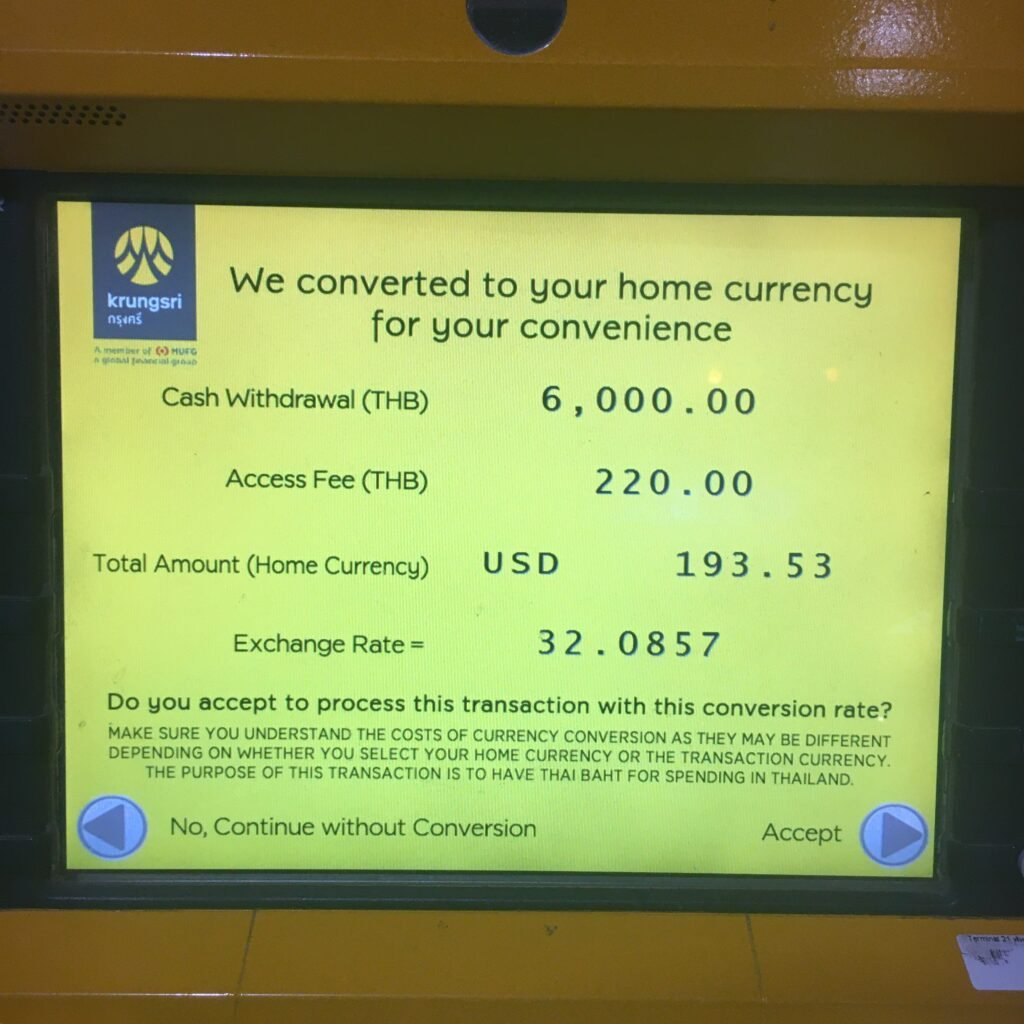
When withdrawing money, most Thai ATMs will show you a screen offering to convert your home currency. Decline, because the rate they offer you will nearly always be worse than the conversion rate your bank will give you.
12. Limit Number of ATM Withdrawals
The standard ATM withdrawal fee at Thai ATMs is quite expensive: typically 220 baht (almost $7 USD). That’s above any fees your home bank may charge. So limit the number of ATM withdrawals you make. Make fewer, larger withdrawals. You can sometimes avoid the Thai ATM fee entirely by going inside a major bank branch with your passport and card to do an over-the-counter cash advance or withdrawal.
Typical maximum daily ATM withdrawal amounts in Thailand usually range from 20,000 to 30,000 baht depending on the bank and card type but 20,000 baht per transaction is the most common. The absolute daily withdrawal limit is ultimately determined by your home bank. Contact them before your trip to check or increase this amount.
13. Mentally Convert Purchases Into Your Home Currency
To keep from overspending with a truly foreign-to-you currency, keep common amounts in mind when making purchases. For example:
100 baht = USD $3
200 baht = USD $6
300 baht = USD $9
400 baht = USD $12
500 baht = USD $15
You don’t even have to memorize them all. Just commit to memory what 100 baht is worth in your home currency, then do some mental multiplication to approximate higher amounts.
Set a few “baht” standards for the most you want to spend on a coffee, lunch, or dinner and stick with it. For example, 100 baht max for a coffee prevents you from spending recklessly at Starbucks. 200 baht for lunch. 400 baht for a full dinner.
If baht seems to slip through your fingers too quickly, consider setting a daily budget and carry only that amount of baht with you.
Planning a trip to Pattaya or Thailand generally? You May Also Like:
Do You Need a Visa to Visit Thailand?
How to Complete your TDAC Form
Thailand Proof of Onward Travel
Thailand Proof of Funds: How Much Money Do You Need to Enter Thailand?
25 Travel Hacks for First-Timers in Pattaya

Pingback: Should You Carry Your Passport With You in Pattaya? - Pattaya Guidebook
Pingback: A Comprehensive Guide on Using the Baht Bus (Songthaew) in Pattaya
Pingback: Best Ways to Get From Bangkok to Pattaya - Pattaya Guidebook
Pingback: How to Stay Safe in Pattaya: Essential Tips for Travelers - Pattaya Guidebook
Pingback: 20 Culture Hacks for Indian Travelers in Pattaya - Pattaya Guidebook
Pingback: How to Get to Sukhumvit (Asoke & Nana) from BKK Airport - Pattaya Guidebook
Pingback: Pattaya First-Time Visitor Guide: Everything You Need to Know - Pattaya Guidebook